
Hello (again)
Posted in: Allow Me to Introduce Myself
Cheers, Vanessa! Looking forward to your contributions

Cheers, Vanessa! Looking forward to your contributions
Hi Clay, I am looking for an immediate purchase of a compact/single phase elect. (no gas) roaster (5 to 10 lbs Batches at time is fine) programable/easy/simple to maitain and operate. I like the idea of the Combi-Oven/UNOX unit your recommeded in this thread (I am assuming I do not need to purchase a separate cooling tray with the UNOX, correct?)
Which specific model/size of UNOX do you recommend for 5-10lbs? Any idea how much it cost? Do you prefer it over a Drum roaster? (I currently have 3 Behmor 1600s and I am happy with the roasting results; but the batch is too small and I need to upgrade/consolidate to a bigger unit)
Thanks!
Welcome! I've got two bresaola's that just hit target weight this week, into the cold smoker they go!
Getting back into the forums after a long time lurking. Been a member for a couple of years but am compelled to be more active. Recently relocated to the Bay Area and am looking for other fine chocolate enthusiasts to connect with.
My new fascination: Fermentation. It falls in line with my other loves (cheese, wine, salumi, whiskey). By day I preach pork for a salumi artisan in Marketing. When I can I am continuing my chocolate education.
Excited to explore!
Cheers,
Vanessa
No need for disclaimers 8-) your opinion is just as valid as anyone elses! I always like hearing the perspective of folks as to what's important to them, and what their thought processes are regarding their informed perspective. Thanks for sharing yours!
Hi Sebastian,
I need to add first that this is my opinion only and applies to batch roasting process on smaller side of batch up to 300kg. Continuous roasting processes are completely different ball game.
Opinion based partly on experience (we use a Sirocco), partly on engineering knowledge and partly on conversations with people in the industry.
Geometry of roaster: spherical shape plus internal baffles result in beans being very well mixed and evenly heated this gives a uniform roast.
External burner coupled with single pass for hot air reduce temperature inertia and allow very good temperature control, single pass also helps to remove unwanted flavours. This is not as energy efficient as nib roasters where air is recirculated.
A number of trials have proven that matching the roast results from ball roasters using drum roasters is not possible. This is one of the reasons why Food Masters are working to resurrect the ball roaster.
We are about to commit to a new cocoa bean processing plant and if the new ball roaster was available and proven in larger sizes it would have been our preference. Unfortunately only small lab size machines have been built so far so we will go with drum roasting.
I would be interested in other opinions.
Out of curiosity Peter - what makes you say that's one of the best whole bean roasting technologies?
It would have no impact on reheology.
The best way to remove the shell is to 'pre roast' or micronize the whole beans to faciliate some moisture removal from the shell to reduce it's adhesion to the nib, and result in it's easier separation from the nib.
Hi Michael,
My hope was that these might be helpful for others so I am glad you found it useful.
cheers,
Eric
Hi there, is anyone cracking unroasted beans, winnowing, then roasting the nibs? I am curious whether this would create a less viscous chocolate since more of the cocoa butter would in the nibs and not absorbed by the husk. Also, is there a trick to cracking unroasted beans. Thanks!
I have a new EZTemper that I'm selling. Purchased less than 6 months ago. It was used only once or twice. Mint condition and works like a charm! I found that I simply don't have a use for it as I have a continuous tempering unit.
Here's a link to EZTemper if you'd like more info on it, http://www.eztemper.com
The unit is $999. new includes shipping. I'm selling this one for $875. plus shipping.
Thanks
Food Masters are trying to resurrect the Sirroco roaster which is one of the best technologies for whole bean roasting. They will have all the modern controls (temperature/time curves, air flow etc) from touch screen PLC.
I have seen a 25kg machine in their workshop last year (made for a Japanese manufacturer) and I was very impressed.
This may suit the OP much better than Selmi roaster.
pictures asking $500 OTO
Michael -
Welcome to TheChocolateLife!
Where in Peru are you doing this work?
:: Clay
Thanks sebastian!
Greetings all! By way of introduction, my name is Michael. I love flavorful, minimally processed, high percentage dark chocolate. I currently live in Peru and have been growing several T. cacao varieties for almost 5 years. Presently, I am learning how to ferment and dry cacao from my current (second year) harvest focusing on developing flavor. It is tough work, but very satisfying especially in the context of a complex agroforestry system and forest garden. I am also very interested in finding a balance between growing a high quality economically viable cacao harvest and practicing tropical rainforest/biodiversity conservation.
Eric, thanks for posting this useful resource!
Yes, I have a pretty small shop--have two X3210s and a Rev 1. I googled it and it looks like I can buy a small amount.
I'm taking it you're working on very, very small scale. It might be hard to find fluid lecithin if that's the case - you might find some at a health store in capsules that you can pull apart to get to the lec that's inside? I've never really spent any time trying to identify ultra small quantities of lecithin - perhaps others on the board can assist.
Thanks, Clay and Sebastian. Clay, the Chocovision brings it to 108. I had her up the temp, and it finally melted, but she said it was "like Crisco--super thick and waxy." I asked her to add some cocoa butter, but she had already dumped it out of the machine.
Sebastian, I bought it from a chocolatier who worked out of her home. Have no idea how it was stored.
Where would I buy fluid lecithin?
It's probably because it's absorbed moisture. It's likey either old, stored improperly, or both. Distributors are terrible at this, so if you're not buying direct from the MFR, this will be a common problem. The absorpbed moisture is resulting in it being very thick. Add 0.1-0.3% fluid lecithin to it when melting, and give it lots of agitation (like in a kitchenaid mixer). It will likely never revert to what it's supposed to be, but depending on how much moisture it's absorped, you may be able to bring it back into the realm of workabilty.
What temperature is the Chocovision set for? The Chocoley site says get white chocolate to 110F but IIRC the basic melt point in the Chocovision machines is set for 115F.
I would contact their help line and ask them directly.
I bought some white chocolate (Chocoley V125 Pure Indulgence) to help out another chocolatier who was leaving town. My employee just let me know that it isn't melting. It's been in our Chocovision X3210 for 40 minutes and has barely melted. Also tried it in our Rev 1, been going for 35 minutes and barely melting. Why wouldn't this melt?
Please contact me ASAP at 678-464-1452 or jlmsales.rposey@gmail.com!
Thanks,
Ryan Posey
Gap - perhaps it'll be a pop-up book, written in childrens style 8-) Now that'd be a challenge!
Ning-geng-ohg - the best way to align on flavors is to create a set of standards, and taste them together. it is really, really, REALLY difficult to create a shared lexicon with words alone. For example, one might take a Domori madagascar bar, split it in half, and then one of us taste it and desribe it, while the other one tastes it so that we're literally tasting the same thing and aligning on the vocabulary used to describe it. I'd probably not use terms like bright to describe a flavor profile, but words like lactic acid, acetic acid, citrus (and perhaps break it down to more specificity), etc.

What a book it would be if he did!!
Sebastian, who's this person?! I'm so looking forward for some literature on cocoa roasting, although there is a wealth of data from coffee roasting, it would be so good to have a source to shed some light on cocoa.
Also on your comment about a standard lexicon, I take bright as a profile with detectable acidity, what level is optimal is totally subjective but at least we can agree on relative terms, "this roast profile is less bright than that one". Yes?
16" APV Enrobing line w/ 450# Savage Melter and cooling tunnel $65k obo
10" BES (Bakery Equipment Sales) Enrobing Line w/ Cooling Tunnel $10k
5" Smith Enrobing Line, Pre-Bottomer, Cooling Tunnel $15k
We manufacture a full line of chocolate confections as well as salt water taffy and have an abundance of overflow equipment we are trying to move out! Let us know if you are looking for something in particular...chances are we may have it!
A lot of my images are too large to upload, I was able to upload pics of the APV line but not the others. If you are interested I am happy to email them.
Thanks!!
Located in Portland, OR
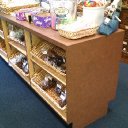
from candy store 4 years old,would like to sell all three ,but OTO on indivdual pieces, or all three. looking for $6000.00 for all three,OTO.
72" x24" x48" refrigerator with plexi's for candy
54 x 34 x 24 counter 1
84 x 34 24 counter 2
Hello Clay,
Thanks for the useful info and insights, sounds like I'll be ordering a 50L Kleego to try out. I've already decided to move away from stone grinding for production, I would have to agree with all of the limitations you mention for the smaller grinders. Yes, the revolving drum driven by a powerful 1- 1.5hp motor in the larger versions is a potential OSHA /Liability issue to my mind too.
With a Kleego I will be able to use a data logging system to profile the conching process, another useful feature of this particular set up. I don't have an option for a larger Conche 100L - 250L set up yet until we move downstairs, but the faster throughput of the Kleego will work for us presently.... I'll keep you posted....
Cheers Mark
Actually, to amend my previous statement, there ARE very good references for small producers on roasting, he's just not written a book yet
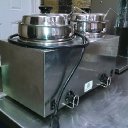
Fudge warmer, was in candy store / ice cream store. less than 4 years old. asking $350 OTO
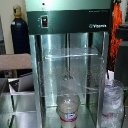
Vitamix Professional Blender , used in candy/ ice cream store, less than 4 years old.
The "brightness" I am talking about is specific to fluid-bed roasters like the Selmi and Coffee Crafters, and drum roasters with fan control that enable umping lots of air through the drum during roasting.
Very few convection ovens give you control over fan speed or humidity, which is one of the reasons the Unox ovens are interesting. Sebastian is right - the way you load the pans will have an affect on heat transfer, as will the use of perforated versus solid pans. Sebastian is also right that there are no good references on roasting for small producers.
I've been to the Eataly in Milan and Turin several times and never saw Gardini. If it's there now - that's new. And welcome.
The Eataly in Milan - when I was there last - was in the basement of a ... department store!
Mark -
Sorry for the delay replying. I saw this when you posted it (on my phone) and just found it again.
There are Kleegos at French Broad (2) and Starchild, among others.
The Kleego was designed to take the output of a melangeur and it functions as a real conche. Indian wet mill grinders do not conche effectively or efficienty - there is no control over temperature, no control over airfow, and the shear action is still grinding.
The shear in a Kleego is provided by counter-rotating stirrers. The top stirrer is fixed speed and the speef of the bottom stirrer is adjustable. The working bowl is wrapped with electrical resistance wire and the temp can be adjusted to 60C+. The built–in fan blows something like 100m3 of air/hour, and the temperature is adjustable from ambient up to ~70C. There is a pump that continously circulates the chocolate.
The action of the stirrers beating the chocolate against each other provides the shearing/beating action.
What we've found is that the Kleego can conche many chocolates flat in about 2 hours running it hot. This is not the way people use it, obviously, but what it does give you is headroom. If you can conche a chocolate in two hours (as opposed to two days) you can afford to experiment and create conching profiles. Many people get it hot quickly and run it hot until the acetic acid disappears and then lower the temperatures of the bowl and the air. You can reduce them all the way to ambient and just concentrate on texture development or you can warm things up and play with flavor development.
The great thing is that you have the headroom (in engineering terms) to test. Sometimes people do over-conche, but what they do then is blend small amounts back into other batches. This blending can be done to even tastes out (consistency), but also to create flavors that could not be acheived conventionally.
The RUMBO is a beast - real granite base and stones! - and FBM improves the mechanism to increase efficiency. The newest version has two mechanism for adjusting pressure - one on the drive shaft and one on the axle of each wheel. While the stones weigh on the order of 50kg ea, I was told that the force exerted by the stones exceeds 300kg. There is no easy way to lift the stones and run it loose - that's what the Kleego is for. The RUMBO, even though hot air is built-in, is also not designed as a conche. The hot air is there to warm the stones and to help liquefy the fat in the nibs. Another area of improvement is the scrapers - the RUMBO empties itself, the mechanism doesn't tilt. Also, the bowl does not turn, which eliminates a potential safety hazard.
Just an update, for those who may search this topic in the future:
Based on Clay's endorsement, I contacted Gardini to find out where their products were sold. They said Eataly, which I'll be going to at some point for the experience outside of chocolate anyway, but the real gem came in the form of the only other option they mentioned: la Rinascente. Like Eataly, la Rinascente has multiple locations in all the major cities, but they are considered a department store (and fashion is the focus) rather than a food or grocery store. However, judging by their website, their chocolate game is on point. The chocolate section of the site (linked below) not only shows all the brands they carry, but also which stores stock each brand! Moreover, there are some other Italian brands I had not heard about mentioned on the site as well. Now, not only do I know where to find the brands I was looking for, but also what to do in Milan on a Monday! Perfetto!
https://www.rinascente.it/rinascente/en/W0010/W0304/W1955/food/packed-chocolate/gardini/
Enjoy!
This is an annotated bibliography about cacao articles that I wrote for a class I took last year. These are summaries of 20 articles about cacao cultivation that I researched. They may be of interest to many chocophiles and hopefully help with the research that others are doing. The file is attached as a PDF.
Cheers,
Eric
It's more fearmongering for attention, and, ultimately, probablyn driven by a laywer who's looking for business. Likely in california. They claim that 'no one knows how they got there' - which is simply wrong. it's been understood for decades where the trace heavy metals comes from, and it happens with literally all crops that are grown in the vocanic soils.
Edited to add - a little information is a dangerous thing, and if it's not driven by a lawyer looking to create an environment where he can create litigation, if they are ultimately successful in legislating the warnings they feel are needed, chocolate companies will likely cease commercial activities in California. The list of companies they had tested shows a pretty fundamental lack of understanding of the supply chain, as many of those companies aren't making their own chocolate.






 F.anntbib.choclife.pdf - 507KB